I don’t design products the same way anymore
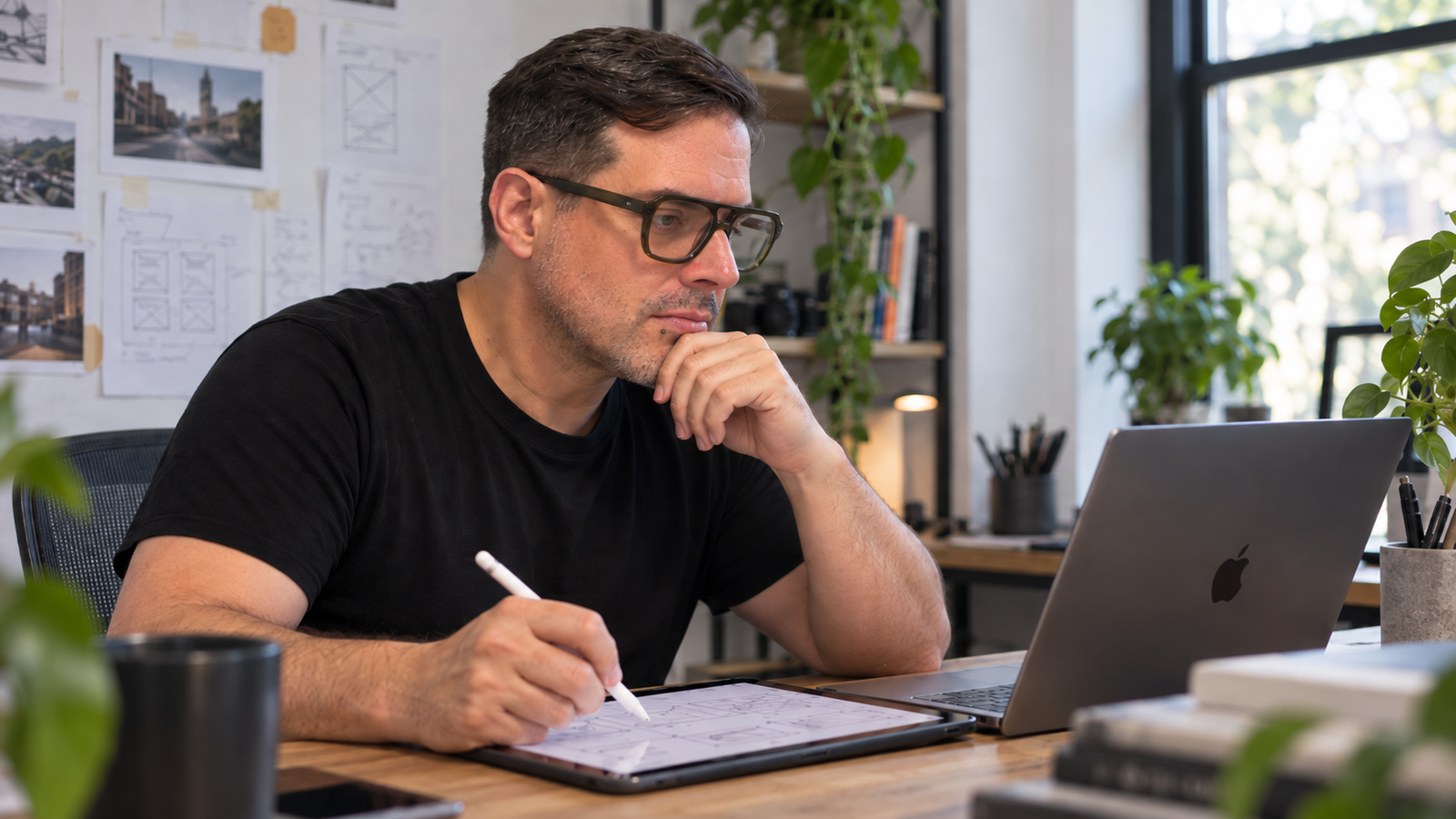
For most of my career, the process was pretty clear. You research the problem, understand the business, work on the brand, define the product, design the experience, create the UI and, at some point, the design moves into development.
Of course it was never completely linear, and good teams have always worked collaboratively. But there was still a fairly clear separation between designing the product and building it.
For me, that line has changed a lot. And I think I’m a better designer because of it.
Over the last year, my process has become much broader. I still start in the same place: understanding the problem properly. Research still matters, talking to people still matters, testing ideas with real users still matters and understanding what a business actually needs rather than what we assume it needs still matters.
If anything, all of that matters even more now because the speed of building has increased so much. When you can move faster, you can also move in the wrong direction faster.
What changed is what happens after that.
Today, when I work on a product, I can move from discovery into the brand, then into the visual language, the product system, the UX and UI, and continue much deeper into what happens after the design. I can test how things behave, work closer to the implementation, prototype ideas in a much more realistic way, understand where something breaks and see whether an interaction that looked great in Figma still makes sense once it actually exists.
Then I can go back and change the design.
That loop is much tighter now.
A good example is Bargly . When we started working on it, the problem wasn’t “we need an app for local businesses.” That would have been a terrible starting point.
The interesting part was understanding the relationship between local businesses and the people who shop with them. What makes somebody come back? What makes a reward useful? What makes an offer feel relevant rather than annoying? What does a small business actually have time to manage? What does the shopper notice and what do they completely ignore?
Those questions shape the product long before the interface exists.
From there, we worked on the positioning, the brand, the visual language, the product structure and the experience. And then the work continued.
I work closely with Pedro Orlando throughout that process. We test things, challenge each other, look at the product from different angles, work through the technical implications and put things in front of people. We learn from what they do, not only from what they say, and then we change things.
That part is important because I don’t think the evolution of my process is about becoming some kind of one-person studio that does absolutely everything alone. Quite the opposite.
I think understanding more of the full process has made collaboration better.
When I talk to Pedro about a technical decision now, I understand much more of the consequences. When we discuss how something should behave, I can think about the design and the implementation at the same time. When something becomes too complicated, I can understand why. And when we test something and it fails, I can get closer to the real reason instead of only looking at the interface.
That changes the conversation. And it changes the design.
There are things I would probably have designed differently a few years ago, not because they were bad ideas, but because I was looking at a smaller part of the system.
Now I think much more about what happens before, during and after the screen. I think about the data, the logic, the edge cases, the states, the behaviour, the things that can fail and the things that need to be simple because somebody has to use them every day.
And sometimes the most useful design decision is not adding something. It is removing it. What I love to call, MVP...
That has always been true, but it becomes much more obvious when you’re closer to the implementation.
AI has accelerated this enormously. Not because AI magically creates the product for us. It doesn’t.
But it allows me to move between different parts of the process much faster. I can explore, prototype, test, write code, research, analyse and debug in a much tighter loop, then use what I learn to go back and improve the design almost immediately.
That is probably the biggest change for me.
The implementation is no longer something that happens after the design. It is part of the design process, and the design process continues during implementation.
That feedback loop has become incredibly valuable. I no longer have to wait until something is fully built to discover that an idea doesn’t behave the way I expected. I can find out while we are building it, and because we can learn faster, we can correct faster.
That does not make research and user testing less important. It does not make engineering less important, and it definitely does not mean teams are less important.
It means the boundaries between disciplines are becoming more flexible.
For me, that has been a huge improvement.
I understand more of the system. Pedro understands more of what I’m trying to achieve through the product and the design. We can make decisions together with much more context, and when we put those decisions in front of real people, we can react much faster to what we learn and what we need to improve.
I still think of myself as a designer. That is the foundation of how I approach problems.
I still care about how something feels, how it communicates, how it behaves, whether somebody understands it, whether the product has a clear identity and whether all the pieces belong together.
But the radius around that work has grown, and I really like that...
I think the interesting part is the opposite. Designers can understand more. Developers can prototype more visually. Product people can get closer to implementation. Small teams can move between disciplines much more naturally.
And AI can help all of us shorten the distance between an idea and learning whether that idea is any good.
For me, the biggest change has not been that I can do more things.
It is that I can see more of the product.
And once you see more of the product, you make different decisions.
I think better ones.